
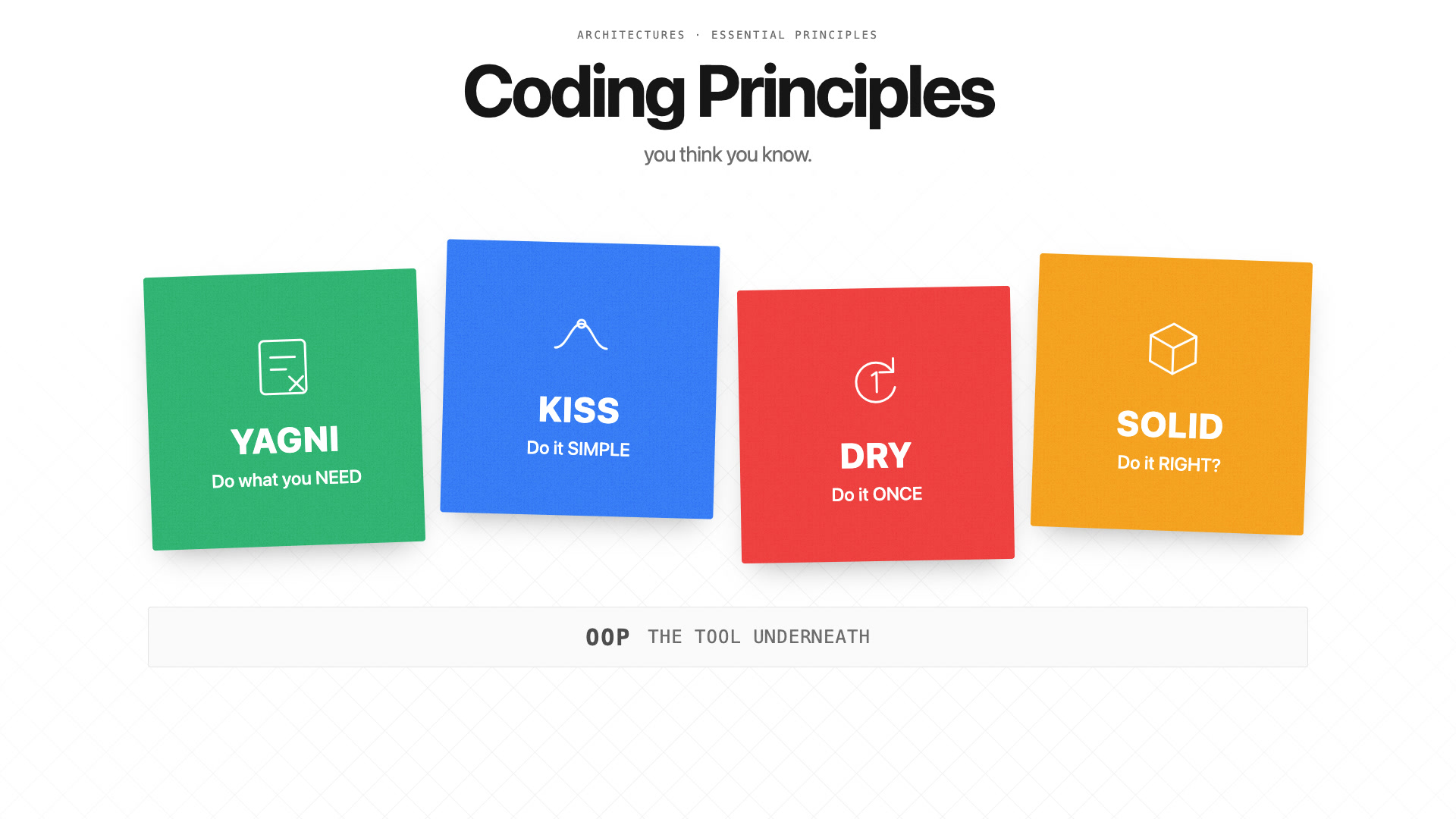
Every WordPress developer has heard of DRY, KISS, YAGNI and SOLID. Fewer can say when each one helps and when it gets in the way. That gap matters more now: AI writes the code quickly, and someone still has to decide what shape that code should take. AI writes the code. You own the architecture.
Not knowing them
Without these principles, a WordPress codebase drifts in familiar directions:
- The same sanitizing, the same option keys and the same query copied into five files.
- A
functions.phpthat does everything: hooks, SQL, HTML and settings in one place. - Settings pages, abstractions and “extension points” built for a future nobody asked for.
AI makes all three faster. It will happily repeat a block of code ten times, or wrap a 50-line plugin in five classes and an interface, if nobody tells it otherwise.
Knowing them blindly
The opposite problem is treating every principle as a rule. They do not always agree:
- DRY wants abstraction. KISS wants less of it.
- YAGNI says you won’t need it. SOLID says prepare for change.
Apply all of them at full strength and you get code that is clean on paper and hard to change in practice.
Four principles, four teasers
DRY: Don’t Repeat Yourself. One piece of knowledge, one place in the code. Not every repeated line is a duplicate: wait until the same logic shows up a third time before you extract it.
KISS: Keep It Simple. The simplest thing that works is usually a hook and a function, not a framework of your own. Simple code is easier to review, and you will review a lot of AI-written code.
YAGNI: You Aren’t Gonna Need It. Don’t build the settings screen, the second provider or the “generic” version until someone needs it. Code you don’t write has no bugs and needs no updates.
SOLID: five principles for code that changes. Single responsibility, open/closed, Liskov substitution, interface segregation, dependency inversion. In WordPress, SOLID pays off where the code really does change, for example when you swap a payment or CRM provider behind an interface.
And OOP is not one of them. It is the tool you use to apply them. See OOP for WordPress.
Each principle gets its own episode in this series.
When they conflict
A useful order of decisions:
- YAGNI: do we need this at all?
- KISS: what is the simplest version that works?
- DRY: has this logic really been repeated?
- SOLID: is this part of the code actually changing?
Each step answers a different question, so the principles stop fighting each other.
In an interview
These principles come up in interviews for any WordPress role above junior, usually as “where does SOLID help, and where is it overkill?” A strong answer names a real case and also knows when a small plugin doesn’t need it. More questions like this: 32 WordPress Developer Interview Questions for 2026.
Conclusion
You don’t need to apply every principle everywhere. You need to know each of them well enough to choose. Start with the overview on Essential Principles, or watch the short version.
FAQ
DRY is “Don’t Repeat Yourself”: keep each piece of logic in one place. KISS is “Keep It Simple”: prefer the simplest solution that works. YAGNI is “You Aren’t Gonna Need It”: don’t build features before they are needed.
Sometimes. DRY pushes towards abstraction, KISS against it. YAGNI says don’t prepare for the future, SOLID says design for change. Use them in order: YAGNI, KISS, DRY, then SOLID.
For a small plugin, often yes. SOLID pays off when parts of the code really change or get replaced, such as external services, payment gateways or storage.
No. OOP is a programming paradigm, the tool you use to apply principles like SOLID and DRY. You can write OOP code that breaks every one of them.
More than before. AI produces code fast, including duplicated and over-engineered code. Principles are how you review it and decide what to keep.