
FAQs
questions
FAQ hub aggregating questions from hooks, plugins, jobs, SOLID and WP-CLI sections — for interview prep, code review, and hiring WordPress developers.
Hooks
Can wp_insert_comment fire without a real visitor ever submitting anything?
Yes — any code that calls wp_insert_comment() directly, including import tools, migration scripts, and other plugins, triggers this hook exactly as if a visitor had submitted the comment.
Do these five hooks fire in the order they’re registered in code?
No — they fire in a fixed pipeline order determined by the REST API’s own request lifecycle (rest_pre_dispatch → authentication → routing → rest_prepare_* → rest_insert_*), regardless of when your plugin registers its callbacks.
Does comment_approved always reflect a comment’s final status?
No — it reflects the moderation outcome at the moment comment_post fires. A comment can be manually approved or marked as spam afterward by a moderator, and that later change doesn’t re-fire comment_post.
Does rest_insert_post fire for posts saved through the normal editor, not the REST API?
No — it fires specifically for posts created or updated through a REST API request. A normal editor save fires wp_insert_post and save_post, not rest_insert_post.
Is sanitizing in comment_text enough to prevent stored XSS from comments?
No. comment_text only affects what’s displayed at render time — the raw value is already stored in the database by the time this filter runs. Real protection has to happen at submission, before the comment is inserted.
Hook actions
Can I cancel a deletion from inside delete_attachment?
No — this action fires as notification, not permission. It can't stop the delete from proceeding.
Used in
delete_attachment Hook action
Can I read the image dimensions inside add_attachment?
Not yet — metadata generation happens afterward. Hook wp_generate_attachment_metadata if you need sizes or EXIF data.
Used in
add_attachment Hook action
Can I redirect the user somewhere custom after logout?
Yes — hook wp_logout (or the logout_redirect filter for more control over the target URL) and call wp_safe_redirect() followed by exit.
Used in
wp_logout Hook action
Can I redirect users away from wp-admin on admin_init?
Yes, that's a very common pattern — check current_user_can() and wp_redirect() + exit if the check fails, being careful to allow admin-ajax.php requests through.
Used in
admin_init Hook action
Can I use after_setup_theme in a plugin?
Yes, but it's primarily meant for themes. Plugins usually use plugins_loaded or init instead.
Used in
after_setup_theme Hook action
Hook filters
Can I hide the admin footer text entirely?
Return an empty string from the filter — WordPress will render the footer area with no text.
Used in
admin_footer_text Hook filter
Can I remove a default body class instead of adding one?
Yes — search $classes with array_search() and unset() the key, then return the array.
Used in
body_class Hook filter
Do I still need wp-login.php to exist after filtering login_url?
Only if something still links to it directly. This filter changes what wp_login_url() outputs; it doesn't disable the real wp-login.php endpoint.
Used in
login_url Hook filter
Does an attachment post exist when this filter runs?
No — this fires before wp_insert_attachment() creates the post, so there's no attachment ID available yet.
Used in
wp_handle_upload Hook filter
Does changing wp_mail_from fix WordPress emails going to spam?
It helps, but deliverability mainly depends on SPF/DKIM/DMARC records and your mail sending method — this filter alone won't fix a misconfigured domain.
Used in
wp_mail_from Hook filter
Jobs
Are there freelance WordPress developer opportunities?
Yes. Many engagements start as freelance or part-time WordPress block developer work before a longer hire. Share your GitHub, plugin contributions, and Gutenberg experience when you reach out.
Used in
Jobs Page
Are WordPress developer jobs remote?
Most 4WP.dev collaborations are remote-friendly. Specify timezone and availability when you contact us — whether you are applying for a role or hiring for your distributed team.
Used in
Jobs Page
Can I hire a Gutenberg block developer for a specific project?
Yes — Gutenberg developer for hire covers custom blocks, inner blocks, block bindings, editor sidebar tools, and block libraries for agencies. For full agency subcontract scope, see also For Companies.
Used in
Jobs Page
How do I hire a WordPress developer through 4WP.dev?
Use the Contacts popup on this page or visit Contacts. Share role scope, stack (Gutenberg, REST, WooCommerce, etc.), and timeline. Review the open-source portfolio first to see production code quality.
Used in
Jobs Page
What are the candidate preparation checklists?
Coming soon: structured guides to prepare for WordPress technical interviews — Gutenberg APIs, PHP architecture, hooks, REST, testing, and how to demo a plugin from the 4WP ecosystem or your own repos.
Used in
Jobs Page
Pactices cases Plugin development base 4WP-Plugins
4WP Booking FAQ
Does it require Elementor?
No. Elementor is optional. The Gutenberg block and Оберіть дату
Ваші дані
Запит надіслано
Used in
4WP Booking Page
Is 4WP Booking an official Clinic Cards plugin?
No. Clinic Cards is a third-party service by Cliniccards Corp. 4WP Booking is an independent product by 4wp.dev that communicates with Clinic Cards via their documented API.
Used in
4WP Booking Page
What is Clinic Cards?
Clinic Cards is a cloud CRM for dental clinics — interactive schedule, patient cards, visual treatment plans, finances, inventory, online booking, and eHealth integration. 4WP Booking connects your WordPress site to their public API.
Used in
4WP Booking Page
What patient data is sent to Clinic Cards?
When a visitor submits the booking form: name, phone, email, optional comment, selected service, date, and time. Data is sent only on submit, not during browsing.
Used in
4WP Booking Page
Where is the Clinic Cards API key stored?
In WordPress options on your server. The key is never included in front-end HTML or JavaScript — all API requests are server-side HTTPS calls to cliniccards.com/api.
Used in
4WP Booking Page
4WP FAQ
Are drafts included?
Yes, drafts are also scanned and shown as sources. Status is visible in the “Used in” list on FAQ Cards when sources are enabled.
Used in
4WP FAQ Page
How do category filters stay in sync?
List and Categories share include/exclude even when they sit in different columns. Two categories on the List → the same two in the nav. More on the nav → the List includes those too. Empty include on one side inherits the other; empty on both means all categories. All categories always shows that synced set, not a different universe of questions.
Used in
4WP FAQ Page
How does the plugin find FAQ items?
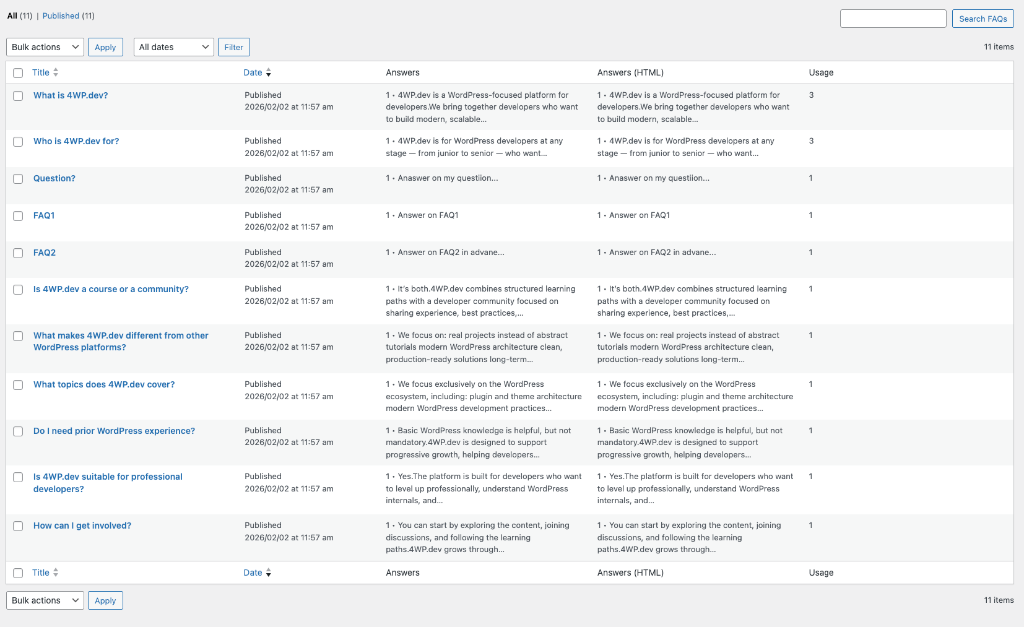
It scans all posts looking for forwp/faq wrapper. Inside, it takes Accordion items/Details blocks and extracts: question, answer, post_id, post_type, and permalink.
Used in
4WP FAQ Page
How to build a FAQ hub?
Complete registry setup, run a rescan, then in the Site Editor add 4WP FAQ Categories (sidebar) and 4WP FAQ List (main column). Optionally add a core Search block and turn on 4WP FAQ → Filter 4WP FAQ List. Questions stay on the real pages; the hub only reads the registry.
Used in
4WP FAQ Page
How to convert Accordion to FAQ?
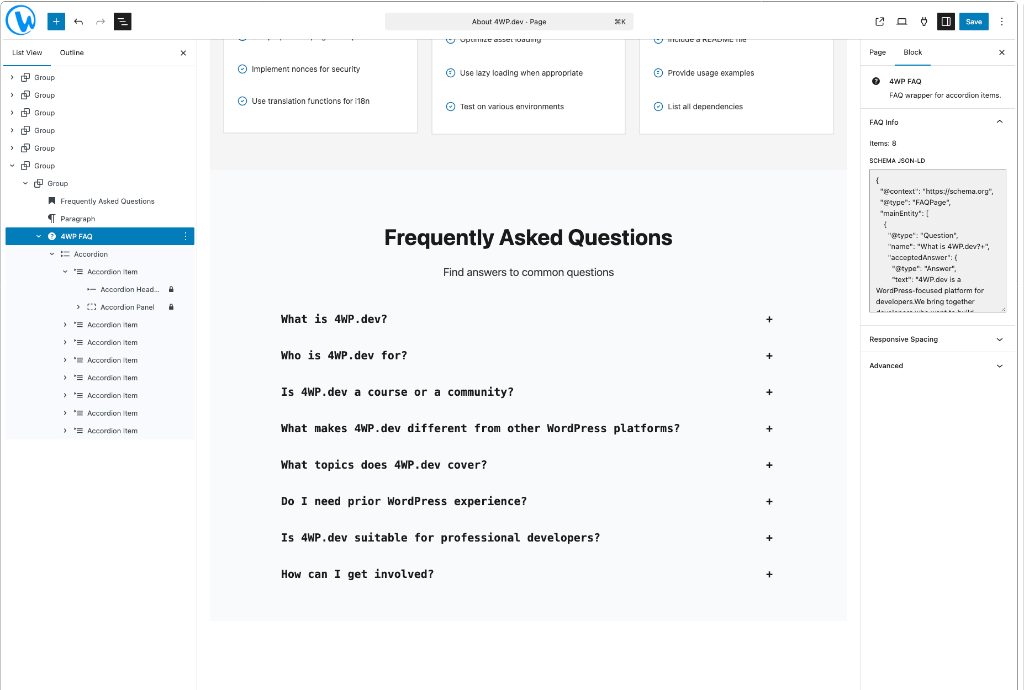
Add core Accordion (or item) → Click “Convert to FAQ” → Plugin wraps it in forwp/faq without changing appearance.
Used in
4WP FAQ Page
4WP Health
Does Apple Health work in the browser?
Not yet. Apple Health has no web OAuth flow. A future release may add an iOS bridge or third-party aggregator through the provider registry.
Used in
4WP Health Page
Is my health data sent to 4wp.dev?
No. Samples are stored in your WordPress database on your server. The plugin does not phone home to 4wp.dev.
Used in
4WP Health Page
What Google APIs are used?
Google OAuth for authorization and the Google Fitness API for activity datasets — steps, distance, calories, and exercise sessions — only after the user consents and an admin saves valid OAuth credentials.
Used in
4WP Health Page
What is 4WP Health?
A WordPress plugin that lets logged-in users connect Google Health / Fitness data — with admin charts, Gutenberg metric blocks, REST endpoints, and a provider registry for future sources.
Used in
4WP Health Page
Where can I get the source code?
Clone or download from GitHub. Part of the 4WP Bundle ecosystem.
Used in
4WP Health Page
4WP Icons
Can I use custom SVG?
Yes. Choose the custom SVG option in the icon library when Lucide does not include your mark — useful for logos and client-specific assets.
Used in
4WP Icons Page
Does it work with core blocks?
Yes. Toolbar controls add icons to Button, Heading, Paragraph, List, and Quote blocks in addition to the standalone 4WP Icon block.
Used in
4WP Icons Page
Is there front-end JavaScript for icons?
No. Icons render as inline SVG on the server. Visitors do not load a Lucide React runtime — keeping pages lightweight.
Used in
4WP Icons Page
What is 4WP Icons?
A Gutenberg block plugin that brings the Lucide icon set (1000+ icons) into WordPress with a searchable picker, custom SVG support, links, and inline icons for selected core blocks.
Used in
4WP Icons Page
Where do I get the plugin?
Source and releases are on GitHub. It powers iconography across 4WP.dev and ships as part of the 4WP Bundle ecosystem.
Used in
4WP Icons Page
4WP Multilingual FSE
Do I need separate templates for each language?
No. Templates keep base slugs like header. You create locale-specific template parts (header-en, footer-de, etc.) or map custom slugs in the admin table.
Used in
4WP Multilingual FSE Page
Does it change the Site Editor or only the front end?
Swapping runs on the front end (and is suspended during admin/REST). Editors still manage all parts in the Site Editor; admin tabs help map, clone, and audit coverage.
Used in
4WP Multilingual FSE Page
Does it work with block patterns?
Version 0.2 adds pattern language scope and filters the block pattern inserter via REST so editors see patterns relevant to the active language.
Used in
4WP Multilingual FSE Page
What does 4WP Multilingual FSE do?
It resolves base FSE template part slugs (header, footer, and custom parts) to language-specific versions on the front end, based on the active Polylang or WPML locale.
Used in
4WP Multilingual FSE Page
What happens if a language-specific part is missing?
The resolver falls back to the base slug so the site keeps working. The Design System tab highlights missing variants so you can clone them in one click.
Used in
4WP Multilingual FSE Page
4WP Planner
Does it integrate with Google Calendar?
MVP includes ICS feed export and per-item “Add to Google Calendar” links. Two-way Google OAuth sync is on the roadmap — see GOOGLE-SETUP.md in the repository for current setup notes.
Used in
4WP Planner Page
Does it publish content or run automations?
No. Planning only — no automated actions. 4WP Planner helps you organize work and due dates; it does not post to WordPress, social networks, or deploy plugins on your behalf.
Used in
4WP Planner Page
Is it on WordPress.org?
Not yet. Install from the GitHub repository. An official directory listing has not been submitted.
Used in
4WP Planner Page
Is it ready for production?
No — early-stage development. The plugin is actively evolving (currently v0.3.0). APIs, admin screens, and calendar sync may change between releases. Use on staging or internal installs until we publish a stable roadmap.
Used in
4WP Planner Page
Is there a REST API?
Yes — namespace fwpp/v1 with routes for projects, plans, items, calendars, insights, and meta. Useful for future dashboards or internal tooling; treat endpoints as unstable during early development.
Used in
4WP Planner Page
4WP Responsive
Can I use custom spacing values?
Yes. Presets use named utility classes; arbitrary values use a has-forwp-*-custom class with a CSS variable (for example --forwp-padding-top-mobile: 150px) instead of inline styles.
Used in
4WP Responsive Page
Do I need a custom block?
No. The plugin extends blocks that already support spacing, typography, and alignment — such as Heading, Paragraph, Group, and List — via sidebar controls.
Used in
4WP Responsive Page
Does it add JavaScript on the front end?
No. Output is limited to utility CSS classes and CSS variables. A single generated stylesheet handles responsive rules — no front-end script dependency.
Used in
4WP Responsive Page
How does it use theme.json?
Spacing and font-size presets are read from the active theme’s theme.json. Breakpoints can be defined in settings.custom.breakpoints; when present, they override plugin defaults and lock conflicting admin fields.
Used in
4WP Responsive Page
Is 4WP Responsive on WordPress.org?
Not yet. The plugin has not been submitted to the official WordPress.org directory. Install and review the source from the GitHub repository.
Used in
4WP Responsive Page
4WP-Bundle
Do I need 4WP Bundle to use other 4WP plugins?
No. Each 4WP plugin works standalone. Bundle is recommended when you run several 4WP plugins and want one dashboard, catalog sync with GitHub, and shared addon blocks in the editor.
Used in
4WP Bundle Page
How do I enable or disable an addon block?
Go to 4WP Bundle → Addons, check or uncheck each addon, and click Save. Disabled addons are not registered on init, so they disappear from the block inserter.
Used in
4WP Bundle Page
How do I install from GitHub?
Download the zip from github.com/4wpdev/4wp-bundle, upload via Plugins → Add New, or use the Bundle dashboard to install sibling plugins from the catalog. Activate under Plugins.
Used in
4WP Bundle Page
How does the plugin dashboard work?
Under 4WP Bundle → Blocks, the UI lists every installed 4wp-* plugin and compares versions against the remote plugins.json manifest from GitHub. You can install missing plugins via download URL, activate or deactivate, update when a newer release exists, and open README or documentation links.
Used in
4WP Bundle Page
Is 4WP Bundle free and open source?
Yes — GPL v2 or later. Source on GitHub, maintained by 4WP.dev. Not on WordPress.org yet; install from GitHub or via the ecosystem dashboard.
Used in
4WP Bundle Page
SOLID Principles in WordPress
Q: Can I use OCP without object-oriented programming in WordPress?
A: Absolutely! WordPress hooks (add_action, add_filter) are a perfect OCP implementation using procedural code. Your functions stay closed (working code), others extend via hooks (adding functionality). OOP adds more tools, but hooks alone achieve OCP beautifully.
Used in
Q: Doesn’t OCP make code more complex with all these abstractions?
A: Initially yes, but it pays off as the project grows. Start simple – a few hooks are enough for small plugins. Add interfaces and abstract classes when you have 3+ similar implementations. The complexity is justified when it prevents breaking existing functionality while adding features.
Used in
Q: How does OCP relate to WordPress plugin updates?
A: OCP is crucial for plugin compatibility. If your plugin follows OCP (provides hooks), users can extend it safely. When you update, their extensions keep working because they’re not modifying your code. This is why editing vendor plugin files is dangerous – updates erase custom changes.
Used in
Q: How many hooks should I add to my WordPress plugin?
A: Add hooks at logical extension points – before/after major operations, when data changes, or when rendering output. Follow WordPress core’s approach: do_action('before_save_'), apply_filters('the_content'), etc. Don’t overdo it – too many hooks make code hard to follow.
Used in
Q: Should every function have a filter in WordPress development?
A: No, only functions that return data users might want to modify. Use filters for content transformation (apply_filters('post_title', $title)), use actions for event notifications (do_action('post_saved', $id)). Internal helper functions don’t need hooks.
Used in
WordPress WP-CLI FAQ: Interview & Code Review Questions
WP-CLI Core Commands
Can I install WordPress in a subdirectory with WP-CLI?
Yes. Pass the full URL including the path to wp core install –url=. Download and config steps stay the same; only the site URL changes.
Used in
Deploy a New WordPress Site Practice Case
Can I run wp core install without wp config create?
No. WordPress needs database credentials in wp-config.php before installation. Without config, WP-CLI cannot connect to MySQL and the install will fail.
Used in
Deploy a New WordPress Site Practice Case
Do I always need wp db create?
Only when the database named in wp-config.php does not exist yet. On shared hosting the database is often pre-created — then skip this step. On local dev, create it with WP-CLI.
Used in
Deploy a New WordPress Site Practice Case
Should I pin a WordPress version when downloading?
For most installs, use the latest stable release without –version. Pin a version only when you intentionally need parity with production or a legacy environment.
Used in
Deploy a New WordPress Site Practice Case
What directory should I run wp core download in?
Use an empty directory for a fresh site. WP-CLI downloads core files into the current working directory. Mixing with existing files can leave stale plugins or themes from an old project.
Used in
Deploy a New WordPress Site Practice Case
WP-CLI Database
Does wp db import drop the existing database before importing?
Yes. WP-CLI runs the .sql file against the current database, which typically begins with DROP TABLE IF EXISTS statements for each table. The result is a clean replacement of the existing data, not a merge. This is why the export step before import is critical — anything not in the backup file will not exist after the import.
Used in
Database Export and Import Practice Case
How do I know the backup I am importing is from the right environment?
Run grep 'siteurl' backup.sql | head -5 before importing. The siteurl value in the dump shows which site and domain the backup came from. If it shows a localhost or staging URL, you will need to run wp search-replace after the import to fix all domain references.
Used in
Database Export and Import Practice Case
What credentials does wp db import use?
WP-CLI reads the database host, name, user, and password directly from wp-config.php. You do not need to pass credentials on the command line. This is why wp db import backup.sql works without any additional flags.
Used in
Database Export and Import Practice Case
What if the import fails halfway through?
The database may be in a partially restored state. First, check the error message — it usually points to a specific table or SQL statement. If the import file is valid, try running it again (WP-CLI’s import is generally idempotent for standard WordPress dumps because each table is dropped before recreating). If the file itself is corrupted, you need an earlier backup.
Used in
Database Export and Import Practice Case
What is the difference between wp db export and a manual mysqldump?
wp db export is a thin wrapper around mysqldump that reads credentials from wp-config.php automatically. The resulting .sql file is compatible with wp db import and standard MySQL import tools. The main advantage over raw mysqldump is that you do not need to manually pass host, user, password, and database name on the command line.
Used in
Database Export and Import Practice Case
General Questions
About 4WP.dev
Do I need prior WordPress experience?
Basic WordPress knowledge is helpful, but not mandatory.
4WP.dev is designed to support progressive growth, helping developers move step by step toward deeper expertise.
Used in
About 4WP.dev Page
How can I get involved?
You can start by exploring the content, joining discussions, and following the learning paths.
4WP.dev grows through active participation and shared experience.
Used in
About 4WP.dev Page
Is 4WP.dev a course or a community?
It’s both.
4WP.dev combines structured learning paths with a developer community focused on sharing experience, best practices, and real production knowledge.
Used in
About 4WP.dev Page
Is 4WP.dev suitable for professional developers?
Yes.
The platform is built for developers who want to level up professionally, understand WordPress internals, and work with production-grade solutions.
Used in
About 4WP.dev Page
What is 4WP.dev?
4WP.dev is a WordPress-focused platform for developers.
We bring together developers who want to build modern, scalable WordPress solutions through real-world practice, not theory.
Used in
About 4WP.dev Page
For-Companies
Can I hire a Gutenberg block developer for a client project?
Yes. 4WP.dev offers subcontract and direct hire for block libraries, editor UX, plugin MVPs, and production hardening. Review the plugin portfolio first, then request a conversation.
Used in
Can you rescue or refactor an existing WordPress plugin?
Yes — common requests include Gutenberg migration, security hardening, test coverage, REST API cleanup, and SOLID restructuring without breaking live sites.
Used in
Do you build FSE themes and block libraries?
Yes. Full Site Editing themes, reusable block patterns, theme.json design systems, and editor-only block addons for agency design systems are core strengths.
Used in
Does 4WP.dev work with agency white-label workflows?
Yes. Engagements can run under your agency brand with direct technical communication, clear handoff docs, and Git-based delivery your team can maintain.
Used in
How do I evaluate expertise before subcontracting?
Audit open-source repos on GitHub, read architecture docs, inspect release cadence on WordPress.org, and review plugin singles on 4wp.dev — all public proof of how code is structured and shipped.
Used in
For-Customers
Are 4WP plugins free?
Most are open source (GPL v2+) and free to install. Some are on WordPress.org; others install from GitHub, including via 4WP Bundle. There are no hidden license traps.
Used in
For Customers Page
Can I use several 4WP plugins on one site?
Yes. They are built as a suite. 4WP Bundle helps install, activate, and update when you run more than one.
Used in
For Customers Page
Do I need a developer to use these tools?
No. Install from the plugin page or WordPress.org, activate in wp-admin, then follow the short setup on each product page. Settings and blocks live in the WordPress admin and editor.
Used in
For Customers Page
How do I know a plugin is maintained?
Check the latest release on WordPress.org or GitHub, read the product page, and skim the matching article when one exists. Public repos and release notes are the audit trail.
Used in
For Customers Page
What if I need a small custom change?
Start with the product documentation, then contact 4WP.dev for guided setup or a small configuration adjustment.
Used in
For Customers Page
For-Developers
Are there REST API and MCP integration examples?
Yes. 4WP Bundle exposes 4wp/v1 REST endpoints; MCP Abilities connects AI agents to WordPress via the Abilities API — both with public source on GitHub.
Used in
Can I fork 4WP code for client projects?
Yes, under GPL v2+. Fork, adapt, and ship — respect the license and attribution. Many patterns (block wrappers, REST controllers, inventory tables) are reusable starting points for commercial work.
Used in
Does 4WP.dev cover modern Block Editor APIs?
Yes — block.json, InnerBlocks, block variations, Interactivity API, block bindings, Query Loop extensions, and editor sidebar plugins appear across the suite (FAQ, Advanced Code, QL Blocks, SEO Helper, MCP Abilities).
Used in
How does 4WP.dev teach Gutenberg block development?
Study plugin singles under /plugin/, clone repos, and follow guides on hooks, blocks, inner blocks, Interactivity API, and block bindings. Each plugin is a case study — not a toy demo.
Used in
How is 4WP.dev different from generic WordPress tutorials?
Content is anchored in shipped plugins — real settings screens, edge cases, release history, and SEO/GSC workflows. You learn from code that runs in production, not isolated snippets.
Used in
WP-CLI Maintenance
Do I need –allow-root?
Only when you run WP-CLI as root (common on some VPS setups). Prefer a dedicated deploy user that owns the site files. This simulator accepts the commands without –allow-root.
Used in
Secure WordPress Maintenance Practice Case
In which order should I update core and plugins?
Core first, then wp core update-db, then plugins. Plugins often require a minimum WordPress version; updating them against outdated core can cause fatals.
Used in
Secure WordPress Maintenance Practice Case
Should I also back up files, not only the database?
Yes on real servers. Use a dated directory outside the web root for tar archives of the site plus wp db export. This interactive challenge focuses on WP-CLI commands; file archives remain part of the full protocol.
Used in
Secure WordPress Maintenance Practice Case
What does DISALLOW_FILE_MODS actually block?
It disables plugin and theme install/update (and related file editing) from the WordPress admin UI. Updates then happen via WP-CLI or controlled deploy pipelines — which is what you want on production business sites.
Used in
Secure WordPress Maintenance Practice Case
Why does elementor-pro fail with Unauthorized?
Many premium plugins authenticate downloads against the vendor API using a license tied to the site. WP-CLI bulk update may not complete that handshake. Installing a verified zip with wp plugin install … --force --activate is the reliable production pattern.
Used in
Secure WordPress Maintenance Practice Case
Headless WordPress
Can headless WordPress still use SEO plugins like Yoast?
Partially. Yoast can still manage SEO titles, descriptions, and structured data as fields in the WordPress admin, but it no longer outputs anything into a page directly — the frontend has to read those fields via the API and render its own <title>, meta tags, and JSON-LD.
Used in
Can I just use WordPress’s default cookie authentication from a headless frontend?
Only if the frontend shares the exact same origin as WordPress, which is rare in a real headless setup. Across origins, cookie-and-nonce auth runs into CORS and SameSite restrictions that will block legitimate requests unpredictably — a token-based scheme avoids the problem entirely.
Used in
Can the REST API handle authenticated write requests from a separate-origin frontend?
Yes, but not with WordPress’s default cookie+nonce auth, which assumes same-origin. A cross-origin frontend needs a token-based scheme (Application Passwords or a JWT/OAuth layer) — covered in full on the Auth page.
Used in
REST API Backend Page
Do you still need a WordPress theme in headless mode?
A minimal one, yes — WordPress still needs a theme to activate, and some admin-only screens still render through it. But the theme’s templates are irrelevant to what visitors see; all the real rendering logic lives in the frontend application.
Used in
Does going headless break SEO plugins like Yoast?
It doesn’t break the plugin’s admin fields, but it does mean those fields no longer automatically appear in the rendered page — the frontend has to explicitly fetch and render the title, meta description, canonical URL, and structured data itself.
Used in
REST API
Can I add a custom post type’s data to wp/v2 without a custom endpoint?
Yes — registering the post type with show_in_rest => true gives it a full wp/v2-style route automatically, with the same field-extension tools (register_rest_field, meta REST visibility) available on top of it.
Do I need a permission_callback if the route is meant to be public?
Yes, and it should be explicit — __return_true is a valid permission callback that documents the route is intentionally open, rather than an oversight the next developer has to investigate.
Used in
Does showinrest expose a custom field publicly by default?
It depends on how the field was registered — meta fields need an explicit auth_callback if their visibility should be restricted; without one, the default behavior may expose more than intended, so it’s worth checking rather than assuming.
How many routes should share one controller class?
Routes that operate on the same underlying resource — one controller per resource (projects, services, bookings), not one controller for the entire plugin’s API surface.
Used in
How should pagination be enforced on a list endpoint?
With a sensible default per_page and an enforced maximum that a request can’t override, so no single call can pull an unbounded result set regardless of what the client requests.
Uncategorized
Can I rely on WP-Cron for a task that has to run at an exact minute?
No. WP-Cron only guarantees that an event won’t run before its scheduled time — the actual moment it runs depends on when the next visitor arrives. For truly time-critical tasks, you need an external trigger: a system cron or a cloud scheduler.
Can I render Gutenberg blocks as React components?
Yes, with WPGraphQL Content Blocks: it returns blocks as typed data instead of one HTML string, and you map each block type to a component.
RelatedHeadless & Decoupled WordPress: Architecture, Trade-Offs, and Production PatternsGraphQL for Headless WordPress: Schema Design With WPGraphQLFrontend Architecture for Headless WordPress: Next.js, SPA, and Rendering StrategyBuilding a REST API Backend for Headless WordPressAuthentication for Headless WordPress: Beyond Cookies and NoncesDraft & Preview in a Headless WordPress Setup
Can I use this native authentication model for a headless frontend?
No — nonces and cookies require the same origin and an active browser session. A separate-origin frontend needs a token-based authentication scheme instead; see the Headless Auth page for that pattern.
Can I use wp core update –minor on production?
Yes, and it is recommended for automated pipelines. The –minor flag restricts updates to the current major branch (e.g. 6.x → 6.x patch), skipping major version jumps.
Used in
WordPress Maintenance Workflow Practice Case
Do I need @wordpress/data to call the REST API from JavaScript?
No — it’s an optional state-management layer useful once a panel needs shared, reactive state across several components. A single REST call is simpler with plain apiFetch or fetch() alone.
No questions found. Try another search.