
Pactices cases Plugin development base 4WP-Plugins
questions
Answers to common questions about 4WP plugins, including installation, plugin dashboard and addon settings, and how they work with the Site Editor, theme.json, core blocks, patterns, and other tools. It also covers plugin-specific topics such as FAQ item discovery, category filters, multilingual templates, and front-end behavior.
4WP Booking FAQ
Does it require Elementor?
No. Elementor is optional. The Gutenberg block and Оберіть дату
Ваші дані
Запит надіслано
Used in
4WP Booking Page
Is 4WP Booking an official Clinic Cards plugin?
No. Clinic Cards is a third-party service by Cliniccards Corp. 4WP Booking is an independent product by 4wp.dev that communicates with Clinic Cards via their documented API.
Used in
4WP Booking Page
What is Clinic Cards?
Clinic Cards is a cloud CRM for dental clinics — interactive schedule, patient cards, visual treatment plans, finances, inventory, online booking, and eHealth integration. 4WP Booking connects your WordPress site to their public API.
Used in
4WP Booking Page
What patient data is sent to Clinic Cards?
When a visitor submits the booking form: name, phone, email, optional comment, selected service, date, and time. Data is sent only on submit, not during browsing.
Used in
4WP Booking Page
Where is the Clinic Cards API key stored?
In WordPress options on your server. The key is never included in front-end HTML or JavaScript — all API requests are server-side HTTPS calls to cliniccards.com/api.
Used in
4WP Booking Page
Which booking providers are planned after Clinic Cards?
Google Calendar and Calendly are on the roadmap. The plugin uses a pluggable provider architecture — Clinic Cards is the first live connector.
Used in
4WP Booking Page
4WP FAQ
Are drafts included?
Yes, drafts are also scanned and shown as sources. Status is visible in the “Used in” list on FAQ Cards when sources are enabled.
Used in
4WP FAQ Page
How do category filters stay in sync?
List and Categories share include/exclude even when they sit in different columns. Two categories on the List → the same two in the nav. More on the nav → the List includes those too. Empty include on one side inherits the other; empty on both means all categories. All categories always shows that synced set, not a different universe of questions.
Used in
4WP FAQ Page
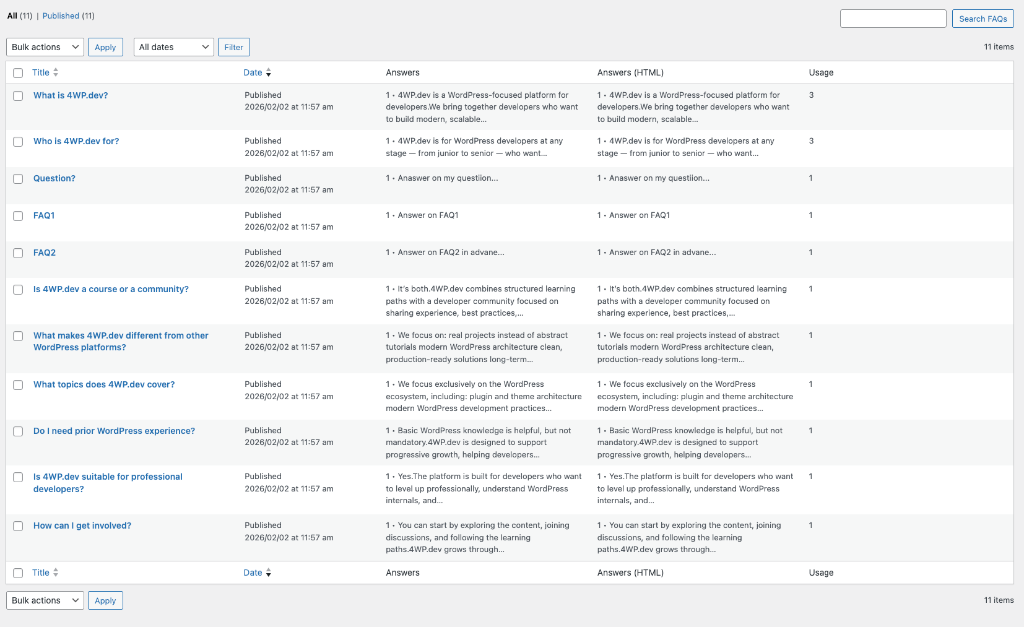
How does the plugin find FAQ items?
It scans all posts looking for forwp/faq wrapper. Inside, it takes Accordion items/Details blocks and extracts: question, answer, post_id, post_type, and permalink.
Used in
4WP FAQ Page
How to build a FAQ hub?
Complete registry setup, run a rescan, then in the Site Editor add 4WP FAQ Categories (sidebar) and 4WP FAQ List (main column). Optionally add a core Search block and turn on 4WP FAQ → Filter 4WP FAQ List. Questions stay on the real pages; the hub only reads the registry.
Used in
4WP FAQ Page
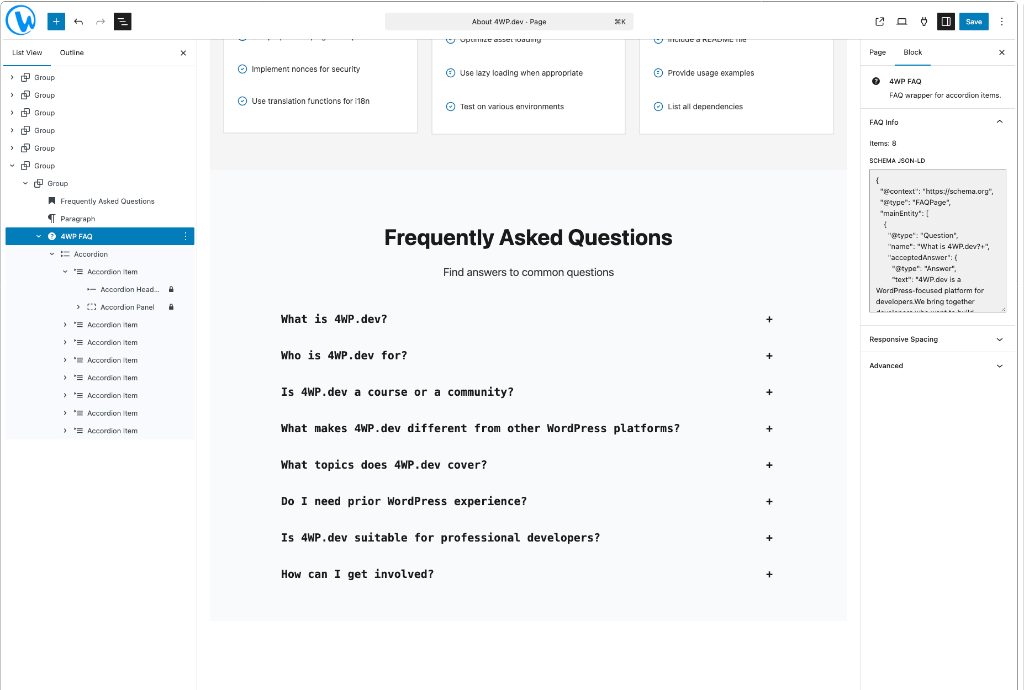
How to convert Accordion to FAQ?
Add core Accordion (or item) → Click “Convert to FAQ” → Plugin wraps it in forwp/faq without changing appearance.
Used in
4WP FAQ Page
How to reuse questions?
Reuse today means the hub: the same registry questions render on a glossary page via 4WP FAQ List. Auto-inserting a question into a new Accordion is still on the roadmap.
Used in
4WP FAQ Page
How to track expansions?
Potential next stage: click tracking. It gives understanding of which questions are actually “live”.
Used in
4WP FAQ Page
Questions from 4WP.dev About
- What is 4WP.dev? Platform for WordPress developers with docs, courses, patterns.
- How do I start learning? Start with Knowledge Base, pick a path, move to courses.
- Is the content free? Most content is free, some advanced courses may require subscription.
Used in
4WP FAQ Page
SEO-friendly category URLs?
Off by default: filter in place, URL unchanged. On: one extra path segment after the current page, e.g. /faq/for-companies/. Opening that URL directly shows only that category. The “All categories” link returns to the host page.
Used in
4WP FAQ Page
What are List, Card, and Categories?
- 4WP FAQ List (
forwp/faq-list) — grouped by category or a single list. Include/exclude taxonomy terms. - 4WP FAQ Card (
forwp/faq-card) — inner template of the List: accordion or heading + answer. Optional “Used in” source links and post-type label. - 4WP FAQ Categories (
forwp/faq-categories) — vertical or horizontal nav. All categories is a replaceable label that still shows the full synced list.
Used in
4WP FAQ Page
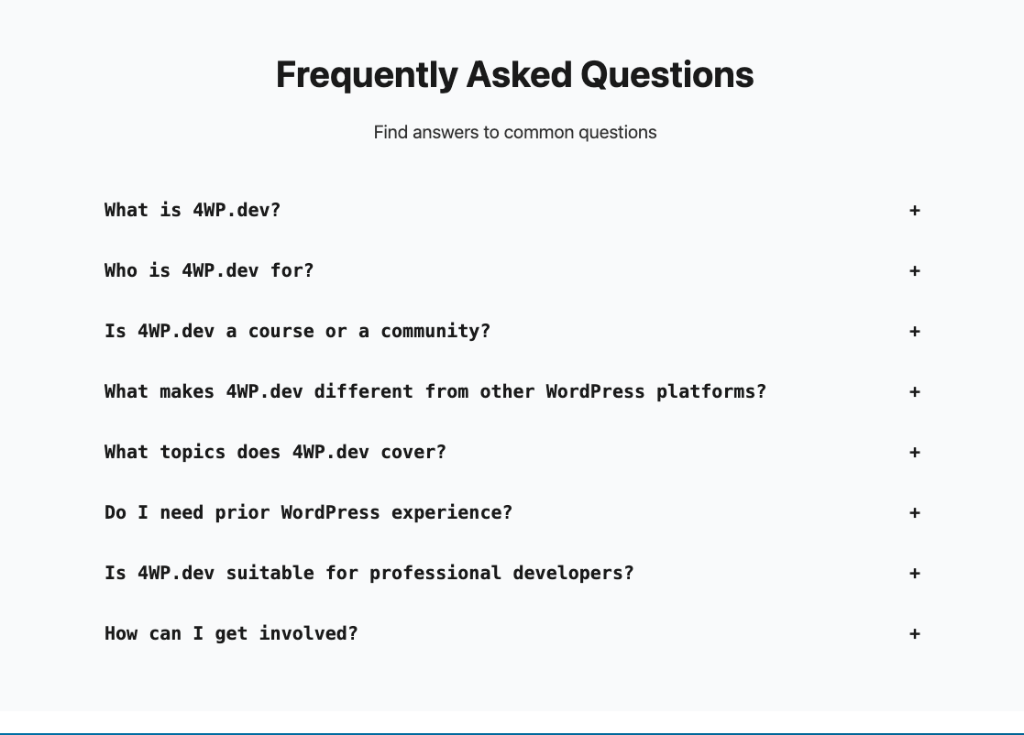
What is 4WP-FAQ?
A smart wrapper around WordPress core Accordion that adds intelligence without breaking design. It adds Schema JSON-LD, an optional question registry, and FSE hub blocks (List, Card, Categories) while working on top of existing content with zero duplication.
Used in
4WP FAQ Page
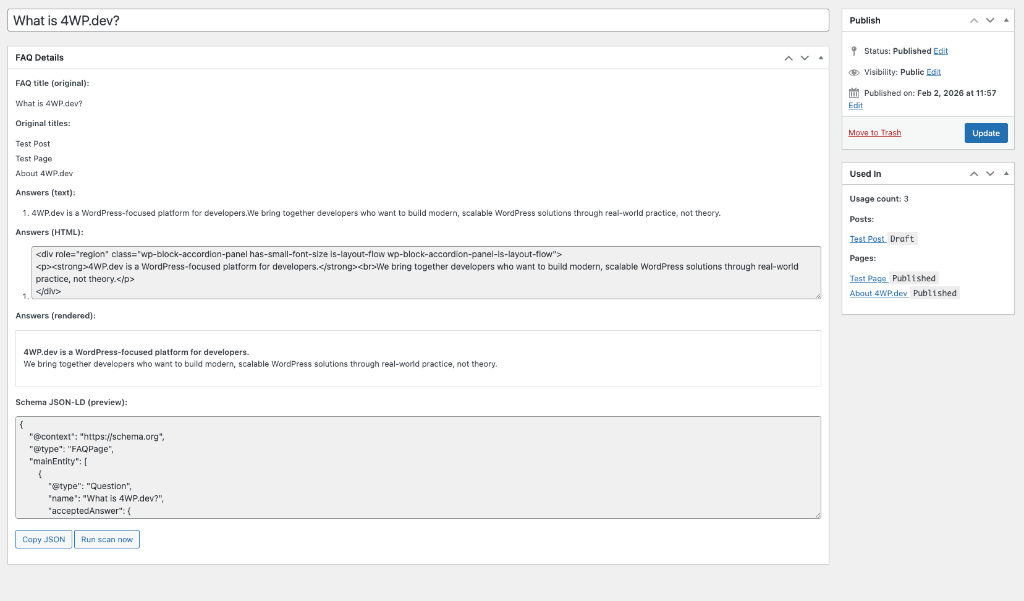
Where to preview Schema JSON-LD?
In the FAQ-CPT page metabox, there is a JSON-LD preview. Copy it with one click. It represents what the plugin generates on the frontend.
Used in
4WP FAQ Page
Why not just another FAQ block?
Because the source of truth is your actual content pages. We do not create duplicates – we read facts from real pages. This gives transparent insight into where questions live, in which posts, and in what versions.
Used in
4WP FAQ Page
4WP Health
Does Apple Health work in the browser?
Not yet. Apple Health has no web OAuth flow. A future release may add an iOS bridge or third-party aggregator through the provider registry.
Used in
4WP Health Page
Is my health data sent to 4wp.dev?
No. Samples are stored in your WordPress database on your server. The plugin does not phone home to 4wp.dev.
Used in
4WP Health Page
What Google APIs are used?
Google OAuth for authorization and the Google Fitness API for activity datasets — steps, distance, calories, and exercise sessions — only after the user consents and an admin saves valid OAuth credentials.
Used in
4WP Health Page
What is 4WP Health?
A WordPress plugin that lets logged-in users connect Google Health / Fitness data — with admin charts, Gutenberg metric blocks, REST endpoints, and a provider registry for future sources.
Used in
4WP Health Page
Where can I get the source code?
Clone or download from GitHub. Part of the 4WP Bundle ecosystem.
Used in
4WP Health Page
Who can see synced health data?
Data belongs to the WordPress user who connected Google Health. Trainers and administrators need explicit capabilities to use the customer picker and health admin screens.
Used in
4WP Health Page
4WP Icons
Can I use custom SVG?
Yes. Choose the custom SVG option in the icon library when Lucide does not include your mark — useful for logos and client-specific assets.
Used in
4WP Icons Page
Does it work with core blocks?
Yes. Toolbar controls add icons to Button, Heading, Paragraph, List, and Quote blocks in addition to the standalone 4WP Icon block.
Used in
4WP Icons Page
Is there front-end JavaScript for icons?
No. Icons render as inline SVG on the server. Visitors do not load a Lucide React runtime — keeping pages lightweight.
Used in
4WP Icons Page
What is 4WP Icons?
A Gutenberg block plugin that brings the Lucide icon set (1000+ icons) into WordPress with a searchable picker, custom SVG support, links, and inline icons for selected core blocks.
Used in
4WP Icons Page
Where do I get the plugin?
Source and releases are on GitHub. It powers iconography across 4WP.dev and ships as part of the 4WP Bundle ecosystem.
Used in
4WP Icons Page
4WP Multilingual FSE
Do I need separate templates for each language?
No. Templates keep base slugs like header. You create locale-specific template parts (header-en, footer-de, etc.) or map custom slugs in the admin table.
Used in
4WP Multilingual FSE Page
Does it change the Site Editor or only the front end?
Swapping runs on the front end (and is suspended during admin/REST). Editors still manage all parts in the Site Editor; admin tabs help map, clone, and audit coverage.
Used in
4WP Multilingual FSE Page
Does it work with block patterns?
Version 0.2 adds pattern language scope and filters the block pattern inserter via REST so editors see patterns relevant to the active language.
Used in
4WP Multilingual FSE Page
What does 4WP Multilingual FSE do?
It resolves base FSE template part slugs (header, footer, and custom parts) to language-specific versions on the front end, based on the active Polylang or WPML locale.
Used in
4WP Multilingual FSE Page
What happens if a language-specific part is missing?
The resolver falls back to the base slug so the site keeps working. The Design System tab highlights missing variants so you can clone them in one click.
Used in
4WP Multilingual FSE Page
Which multilingual plugins are supported?
Polylang and WPML via built-in providers. The plugin auto-detects which one is active and reads the current language slug from that stack.
Used in
4WP Multilingual FSE Page
4WP Planner
Does it integrate with Google Calendar?
MVP includes ICS feed export and per-item “Add to Google Calendar” links. Two-way Google OAuth sync is on the roadmap — see GOOGLE-SETUP.md in the repository for current setup notes.
Used in
4WP Planner Page
Does it publish content or run automations?
No. Planning only — no automated actions. 4WP Planner helps you organize work and due dates; it does not post to WordPress, social networks, or deploy plugins on your behalf.
Used in
4WP Planner Page
Is it on WordPress.org?
Not yet. Install from the GitHub repository. An official directory listing has not been submitted.
Used in
4WP Planner Page
Is it ready for production?
No — early-stage development. The plugin is actively evolving (currently v0.3.0). APIs, admin screens, and calendar sync may change between releases. Use on staging or internal installs until we publish a stable roadmap.
Used in
4WP Planner Page
Is there a REST API?
Yes — namespace fwpp/v1 with routes for projects, plans, items, calendars, insights, and meta. Useful for future dashboards or internal tooling; treat endpoints as unstable during early development.
Used in
4WP Planner Page
What can I plan with it?
Items support typed work units — articles, plugin releases, social posts, tasks, and related studio work — grouped under projects and optional weekly, monthly, or quarterly plans.
Used in
4WP Planner Page
What is 4WP Planner?
An internal WordPress admin tool for planning content, plugin releases, and calendar-driven work across projects, plans, and items. It is designed for studio workflows at 4WP.dev — not as a generic project-management SaaS replacement.
Used in
4WP Planner Page
4WP Responsive
Can I use custom spacing values?
Yes. Presets use named utility classes; arbitrary values use a has-forwp-*-custom class with a CSS variable (for example --forwp-padding-top-mobile: 150px) instead of inline styles.
Used in
4WP Responsive Page
Do I need a custom block?
No. The plugin extends blocks that already support spacing, typography, and alignment — such as Heading, Paragraph, Group, and List — via sidebar controls.
Used in
4WP Responsive Page
Does it add JavaScript on the front end?
No. Output is limited to utility CSS classes and CSS variables. A single generated stylesheet handles responsive rules — no front-end script dependency.
Used in
4WP Responsive Page
How does it use theme.json?
Spacing and font-size presets are read from the active theme’s theme.json. Breakpoints can be defined in settings.custom.breakpoints; when present, they override plugin defaults and lock conflicting admin fields.
Used in
4WP Responsive Page
Is 4WP Responsive on WordPress.org?
Not yet. The plugin has not been submitted to the official WordPress.org directory. Install and review the source from the GitHub repository.
Used in
4WP Responsive Page
What happens if I deactivate the plugin?
Block content remains intact. Responsive utility classes and variables stop applying, so layouts may look different — but no block markup is destroyed. This is by design for a safe fallback.
Used in
4WP Responsive Page
What is 4WP Responsive?
4WP Responsive adds Desktop, Tablet, and Mobile controls for spacing, visibility, font-size, and text alignment on core Gutenberg blocks — through the block inspector, without custom blocks.
Used in
4WP Responsive Page
Where is the generated CSS stored?
By default under wp-content/uploads/4wp-responsive/, cached with a content hash. You can override the storage path in Settings → 4WP Responsive if your deployment requires a fixed location.
Used in
4WP Responsive Page
4WP-Bundle
Do I need 4WP Bundle to use other 4WP plugins?
No. Each 4WP plugin works standalone. Bundle is recommended when you run several 4WP plugins and want one dashboard, catalog sync with GitHub, and shared addon blocks in the editor.
Used in
4WP Bundle Page
How do I enable or disable an addon block?
Go to 4WP Bundle → Addons, check or uncheck each addon, and click Save. Disabled addons are not registered on init, so they disappear from the block inserter.
Used in
4WP Bundle Page
How do I install from GitHub?
Download the zip from github.com/4wpdev/4wp-bundle, upload via Plugins → Add New, or use the Bundle dashboard to install sibling plugins from the catalog. Activate under Plugins.
Used in
4WP Bundle Page
How does the plugin dashboard work?
Under 4WP Bundle → Blocks, the UI lists every installed 4wp-* plugin and compares versions against the remote plugins.json manifest from GitHub. You can install missing plugins via download URL, activate or deactivate, update when a newer release exists, and open README or documentation links.
Used in
4WP Bundle Page
Is 4WP Bundle free and open source?
Yes — GPL v2 or later. Source on GitHub, maintained by 4WP.dev. Not on WordPress.org yet; install from GitHub or via the ecosystem dashboard.
Used in
4WP Bundle Page
What are the system requirements?
WordPress 5.0 or higher and PHP 7.4+. When installing from GitHub source, run npm install && npm run build to compile block addons. Rename the folder to 4wp-bundle if GitHub adds a -main suffix.
Used in
4WP Bundle Page
What built-in Gutenberg blocks are included?
Three addons ship with Bundle: Show More (collapsible content), Swipe Carousel (InnerBlocks + Swiper), and Video Lightbox (trigger opens video overlay). They register only when enabled.
Used in
4WP Bundle Page
What is 4WP Bundle?
4WP Bundle is the core hub plugin for the 4WP open-source suite. It provides a React-powered wp-admin dashboard to install, activate, update, and manage sibling 4wp-* plugins, plus optional built-in Gutenberg block addons (Show More, Swipe Carousel, Video Lightbox).
Used in
4WP Bundle Page
What REST API endpoints are available?
GET /wp-json/4wp/v1/blocks · POST …/plugin-install · POST …/block-toggle · POST …/plugin-update — each requires appropriate WordPress capabilities (manage_options, install_plugins, etc.).
Used in
4WP Bundle Page
Where does the plugin catalog come from?
The dashboard fetches plugins.json from the 4wpdev GitHub org — slugs, versions, repository URLs, and optional GitHub Releases download URLs. Documentation links point to 4wp.dev/plugin/{slug}/.
Used in
4WP Bundle Page
No questions found. Try another search.
Smart FAQ Management
4WP FAQ
Not just another FAQ block. A smart wrapper that adds intelligence
without breaking your design.